


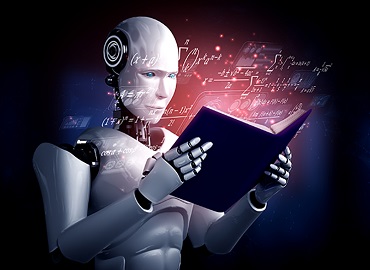
Artificial Intelligence (AI) in Education
By Mohamed Chtatou
AI can assist the teacher (without replacing him) and allows him to identify individuals in difficult situations in classes.
Artificial intelligence (AI) is based on algorithms that allow machines to imitate a form of real intelligence. This innovative technology helps minimize error and improve user experience in various fields, including education. So, what are the role and impact of AI on education?
In the field of education, it is possible to automate certain activities, particularly in terms of assessment corrections. Artificial intelligence also makes it possible to personalize learning according to the needs and assimilation capacities of each person. For example, this new technology can offer students exercises adapted to their learning level.
In addition, AI can assist the teacher (without replacing him) and allows him to identify individuals in difficult situations in classes. This technology also allows teachers to free themselves from repetitive tasks, which helps them personalize and deepen their teaching methods. Artificial intelligence thus opens the door to adapted and customizable learning, making it possible to shape learning paths and guide them according to learner feedback.
Potential of artificial intelligence in education
Artificial intelligence has the potential to revolutionize the way we think about education. From personalized learning algorithms to virtual and augmented reality, AI-powered tools and technologies are helping to enhance the learning experience for students in ways we never thought possible.
AI can bring a wide range of benefits to education. One of the most important is the ability to personalize the learning experience for each student. Using AI, educators can analyze student performance and preference data to create personalized lesson plans and assessments that align with each student’s unique strengths and weaknesses. Additionally, AI can automate administrative tasks such as grading, allowing educators to focus on other important aspects of teaching.
AI-powered tools and technologies can also enhance students’ learning experience in several ways. For example, virtual and augmented reality can make learning more interactive and immersive, while chatbots and other AI-powered tools can provide support to students 24/7. Additionally, AI can be used to create personalized quizzes and games that help students engage with the subject in a fun and interactive way.
Personalized learning is one of the most exciting potential benefits of AI in education. With the ability to analyze data on student performance and preferences, AI can help educators create personalized lesson plans and assessments that align with each student’s unique strengths and weaknesses. This can improve student experience and motivation and ultimately lead to better academic outcomes.
The impacts of Artificial Intelligence on education
Based on an educational triangle (the teacher, the learner and knowledge), it is possible to categorize the impacts of AI on education.
AI ensures the development of several technologies that are likely to replace predictable and repetitive tasks for teachers. For example, this involves automating certain tasks with little added value, such as exam corrections which consume a lot of teachers’ time. However, the teacher’s work goes well beyond the spectrum of automatable tasks. Beyond being a master transmitter of knowledge, the 21st century teacher is a guide to students and a creator of a learning environment. Empathy, kindness, cognitive flexibility and critical judgment are all human qualities that are difficult to reproduce in artificial intelligence, which plays a role of assistance rather than replacement.
For several years, MOOCs have enjoyed great success with students who can learn what they want, when they want and, above all, at the pace that suits them. However, the freedom of choice and abundance of opportunities can create confusion about what to learn. AI can help prevent this phenomenon while offering sequences of exercises or lessons that are more relevant to the student. Also, smart tutors could predict when the student starts to lose interest and warn their teachers, to prevent a possible drop in motivation.
The impact of artificial intelligence on knowledge appears to be at two levels: firstly, the training that students should receive to understand and use AI. Then there is the knowledge that humans should have to live in a world where AI is set to become omnipresent, in an increasingly digitalized world. It is therefore important that teaching programs adapt to this in order to meet students’ need for expertise or development of critical thinking.
The ethical issues of AI in education
Positioning yourself against artificial intelligence in general or specifically, for example in education, is something that is certainly defendable on a philosophical level. As was the case with the appearance of the steam engine and assembly line work, the fear of seeing these machines replace us provokes reactions, including that of categorical rejection. However, these reactions have never led to a ban on these new technologies that increase productivity. They nevertheless helped to raise awareness and perhaps would have prepared the ground for certain movements, such as those aimed at defending workers’ rights.
Currently, there is a gap between the school world and the rest of society. Society is evolving and taking a digital shift at a pace that schools are struggling to keep up with. The appearance of mobile technologies with Internet access is an example that still provokes debate. The opinions expressed range from total bans to those allowing everything that is acceptable elsewhere in society. Thus, discussions on the integration of AI in education seem far-fetched to many. However, if AI takes up more and more space in our daily lives, can schools afford to ignore it? Of course, this does not mean that everything that exists outside of school must necessarily be found in school, but it will probably be necessary to evaluate each application of AI according to its potential.
On the other hand, how can we critically judge AI if we don’t fully understand it? There are many ideas circulating on this subject and some turn out to be biased. When we lack information, we refer to subjective experience, to emotion, to position ourselves. This is why AI often arouses fears. Ethics committees made up of the greatest researchers and developers have been set up to debate the biggest issues. However, as we mentioned previously, the impacts of AI in education are numerous and each use of AI potentially has an ethical dimension that deserves to be examined. The conclusion following this examination could be that of rejection. On the other hand, avoiding considering its applications exposes us to several problems, as is the case with other technologies.
For example, there would be the risk of being manipulated by the AI or by those who control it. Indeed, AI is based on a large amount of data in order to identify, generalize and predict behavior. Some scientists go so far as to say that the machine could soon know the human being better than he himself. On the other hand, don’t the results proposed by AI risk being interpreted as an absolute truth? Too much confidence and dependence on the use of these technologies could lead to a certain intellectual laziness and allow certain ill-intentioned powers to use them to achieve their political objectives.
Letting students appropriate these technologies outside of the school setting, without supervision other than that of parents, is highly questionable. There is certainly a tendency to always want to entrust more mandates to school in order to offer better chances to everyone in life and school cannot constantly replace parental responsibilities. On the other hand, it is necessary to ensure that this supervision is done with all the information attached to it. The question of the role of the education system in the appropriation of technologies using artificial intelligence is entirely relevant, particularly in its ethical dimensions. It is imperative to train our teachers so that they can make informed didactic and pedagogical choices and lead discussions on ethical issues with young people. The goal is to prepare students to control artificial intelligence, and not to be dependent on it.
Conclusion
The future is indeed here. There is no doubt that artificial intelligence in education is gaining popularity among teachers and students. Educators are using AI in the form of EdTech tools to help them create lesson plans or calculate student grades. As for learners, AI can help them complete their projects, homework and even research work. While it cannot be denied that artificial intelligence in 2024 has become a part of our lives, there are still some advantages and disadvantages of AI that deserve a closer look and are still the subject of a debate.
There are important pros and cons to using AI in education to consider. Benefits such as personalization of learning, increased teaching efficiency, access to relevant data and reduced costs can significantly improve the learning experience. However, there are also downsides such as reduced human interaction. There is also a risk of algorithmic bias, fewer jobs for teachers and the need for significant technical resources.
It is therefore essential that educators and policymakers constantly evaluate the impacts of AI. This can maximize benefits while limiting risks. It is also important to view AI as a complement to human teaching rather than a complete replacement. By integrating AI into education wisely, educators can harness its potential to improve learning while ensuring a high-quality teaching experience for learners.
While AI has the potential to revolutionize the way we think about education, there are still many challenges and concerns that need to be addressed. It is important that researchers and developers continue to explore the potential of AI in education and work to address the challenges and concerns that may arise as this type of technology improves and is implemented in the current education system.
https://www.moroccoworldnews.com/2024/02/361022/artificial-intelligence-ai-in-education
